Views: 0 Author: Site Editor Publish Time: 2026-10-20 Origin: Site
Installing the wrong wheel stops leads to damaged vehicle undercarriages, pedestrian trip hazards, and accelerated property wear. Many facility managers overlook this detail until someone trips or files a damage claim. You need the right barriers to protect everyone on site. While often treated as an afterthought, proper specification of parking blocks separates a compliant, low-maintenance parking facility from a continuous liability. Choosing incorrect sizes or flawed placement turns a simple safety measure into a hazard. You must align your facility needs with accepted engineering standards. This guide breaks down the technical requirements for evaluating wheel stop size, material durability, and strategic placement to ensure compliance and longevity. We explore dimensions, hardware, and geometry in detail. You will learn exactly how to secure your parking lot the right way.
Oversized or improperly placed blocks create immediate tripping hazards. Pedestrians often navigate lots while distracted or carrying items. When Wheel Stops protrude into walking paths, people fall. These incidents trigger expensive liability claims. You must also consider Americans with Disabilities Act (ADA) compliance. ADA guidelines require clear, unobstructed pedestrian paths. Misaligned blocks often violate ADA pedestrian clearance paths by blocking accessible aisles. Keeping routes clear protects your visitors and your legal standing.
Modern vehicle design prioritizes aerodynamics. Today, sedans and sports cars feature much lower ground clearances. Drivers expect parking facilities to accommodate these lower profiles. If a block exceeds standard heights, vehicles scrape their front fascias. They pull off bumpers when reversing. Stops exceeding safe heights result in costly undercarriage damage. Angry drivers routinely file damage claims against property owners. You can easily avoid these headaches by specifying correct block heights.
Properly specified blocks act as protective barriers. They stop rolling vehicles before they strike vital structures. Property owners use them to defend EV charging stations from accidental impacts. They also protect fragile storefront glass and utility poles. Without a physical barrier, drivers rely solely on depth perception. This often fails during bad weather or poor lighting. A well-placed block provides physical feedback to the driver. It protects expensive facility infrastructure from continuous minor collisions.
Different vehicles require different barrier widths. For standard commercial passenger vehicle lots, you should specify 6-foot lengths. This length covers the track width of most standard cars and SUVs. However, commercial truck stalls require longer barriers. You will typically use 8-foot lengths for heavy-duty truck parking. You might also use continuous 8-foot barriers to block off unauthorized driving zones.
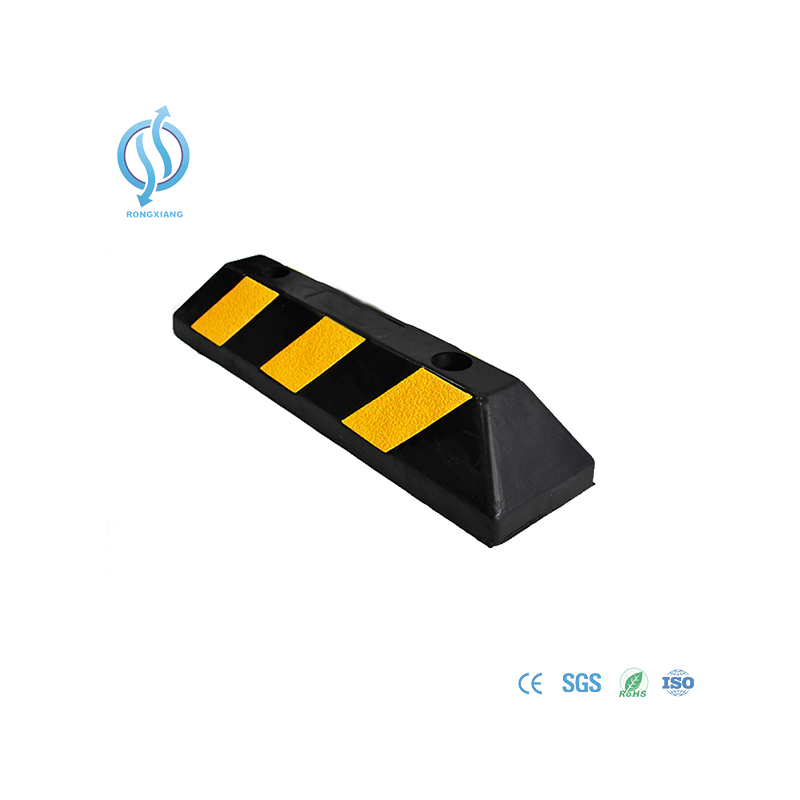
Height determines whether a vehicle will sustain damage. The optimal height ranges from 4 to 5 inches. You must also consider the base width. A standard base spans 6 to 8 inches for stability. These parking wheel stop dimensions rely on basic physics. When a heavy tire strikes the barrier, it creates lateral force. A narrow base easily rolls over or snaps. A wider base prevents roll-over during tire impact. It distributes the kinetic energy safely into the ground.
Facility managers should evaluate their lot before ordering materials. You can use this simple framework to audit your fleet and visitor profiles.
Table 1: Standard Vehicle Clearance vs. Wheel Stop Height Chart
| Vehicle Type | Average Front Clearance | Recommended Block Height | Recommended Length |
|---|---|---|---|
| Sports Cars / Sedans | 5.5 to 6.5 inches | 4 inches | 6 feet |
| Standard SUVs / Crossovers | 7.0 to 8.5 inches | 4 to 5 inches | 6 feet |
| Commercial Delivery Trucks | 10+ inches | 6 to 7 inches | 8 feet |
Concrete represents the oldest standard in parking facility design. Many contractors still default to it out of habit.
Engineers increasingly prefer flexible materials for surface lots. High-quality rubber parking stops offer distinct mechanical advantages.
Plastic models provide an alternative to rubber, focusing on visual longevity.
Proper geometry protects your curbs and walkways. You must calculate standard vehicle overhang accurately. Placing a block exactly at the curb line always fails. When the tire hits a block at the curb, the car's nose extends past it. This crushes landscaping and blocks sidewalks. We use a standard setback rule to prevent this. You should place parking lot wheel stops 2.5 to 3 feet from the front of the parking stall. This specific distance limits vehicle overhang to protect sidewalks and fences.
Spacing between adjacent stalls matters for pedestrian safety. You should never align blocks continuously without breaks. Leave a minimum 3-foot gap between adjacent barriers. This gap allows safe pedestrian passage between parked cars. It also prevents your lot from flooding. Continuous barriers trap debris and rain runoff. A 3-foot gap ensures water flows freely to your drainage grates.
Ignorance of local codes does not protect you from fines. You must reference local DOT standard drawings before laying out your lot. ADA guidelines dictate strict rules for accessible aisles. Barriers must never protrude into these marked zones. If a wheelchair user cannot navigate around a barrier, your facility fails compliance. Always double-check your lateral spacing against federal accessibility standards.
Preparation dictates the lifespan of your installation. You need a swept, absolutely level surface. Sweeping removes loose gravel and dust. Debris prevents blocks from sitting flush against the ground. Warn your maintenance teams against installing over major potholes. You should never install over a deteriorating sub-base. The anchors will simply pull chunks of loose asphalt away under impact. Always patch and seal the substrate first.
A successful wheel stop installation relies on matching hardware to the ground material. Using the wrong fastener guarantees failure.
Mechanical anchors handle the primary load, but adhesives offer extra security. Discuss the optional use of structural epoxy with your installation crew. We highly recommend epoxy in high-traffic commercial zones. Delivery trucks and aggressive drivers put immense sheer stress on anchor pins. Applying epoxy beneath the block bonds it directly to the substrate. This drastically reduces sheer stress on the metal hardware. It keeps the barrier locked in place for years.
Wheel stop specification represents a careful balance of dimensions, material science, and precise placement geometry. You cannot simply drop blocks on the ground and hope for the best. Poor choices lead to property damage, injured pedestrians, and frustrated drivers. Proper sizing protects modern low-clearance vehicles. Smart material selection prevents winter cracking and UV degradation. Accurate geometric placement keeps your sidewalks clear and accessible.
You should take immediate action to secure your facility. First, audit your parking lot substrate to determine if you have asphalt or concrete. Next, measure your typical stall depth and note any intersecting walkways. Finally, request material samples or freight quotes based on the total linear footage required. Proper planning today guarantees a safer, lower-maintenance parking lot tomorrow.
A: Typically 30 to 36 inches to account for the front overhang of standard passenger vehicles. This setback ensures the vehicle's bumper does not strike the wall, damage fencing, or block pedestrian walkways.
A: For most commercial applications, rubber offers better longevity, lower installation costs, and reduced risk of vehicle damage, though concrete remains viable for heavy industrial use. Rubber simply flexes and absorbs impacts better in standard lots.
A: Mechanical anchoring (spikes or lag bolts) is strictly required. Epoxy is a supplemental reinforcement, not a replacement for hardware. You should use epoxy in high-traffic areas to reduce sheer stress on the pins.
A: Concrete typically lasts 5–10 years before significant spalling; high-quality rubber or plastic can last 10–15+ years depending on snowplow activity and traffic volume. Regular visual inspections help maximize their useful lifespan.
 English