Introduction
What defines responsible parking today? Commercial projects must balance safety, cost control, and sustainability at once. Parking areas shape first impressions and influence long-term liability. Recycled rubber Wheel Stops offer a practical solution. They reduce waste, lower maintenance needs, and support green building goals. In this article, you will learn how Wheel Stops strengthen modern parking management for sustainable commercial development.
The Role of Recycled Rubber Wheel Stops in Sustainable Parking Design
Closing the Loop with 100% Post-Consumer Tire Materials
Recycled rubber wheel stops are produced from post-consumer tires. This process diverts large volumes of rubber waste from landfills. Each installation supports circular economy practices. Instead of using new raw materials, we reuse existing resources. It reduces extraction demand and industrial processing impact. Commercial projects benefit from visible sustainability measures that tenants and stakeholders recognize. Using recycled-content wheel stops sends a clear message. The project values environmental responsibility and practical innovation.
Lower Carbon Footprint Compared to Concrete Alternatives
Concrete production generates significant carbon emissions. Cement manufacturing alone accounts for roughly 7–8% of global CO₂ emissions (data needs verification). Recycled rubber wheel stops require less energy during production. They also reduce heavy transport loads due to lighter weight. When installed across large commercial parking areas, the embodied carbon savings can become meaningful. Developers who measure project carbon footprints will find rubber wheel stops support lower environmental impact strategies without compromising performance. Include wheel stops in embodied carbon calculations during early design planning to improve sustainability reporting.
Supporting Green Building Certifications and ESG Goals
Many commercial developments now pursue LEED or similar certifications. Recycled materials contribute toward credit categories such as material sourcing and waste reduction. Recycled rubber wheel stops can help support these goals. They also align with corporate ESG frameworks that require measurable environmental action. When investors review sustainability disclosures, visible material choices matter. Wheel stops may appear small, yet across large properties, they demonstrate responsible procurement decisions and long-term environmental planning. Small infrastructure components can collectively influence sustainability scoring outcomes.

Environmental and Economic Advantages of Rubber Wheel Stops Over Traditional Materials
Reduced Installation Emissions and Resource Use
Rubber wheel stops are lightweight. One installer can often position and secure them using basic tools. It reduces fuel consumption from heavy machinery and lowers site disturbance. Commercial sites benefit from faster turnaround and less operational disruption. It also reduces noise and dust exposure for nearby tenants or customers. Efficient installation improves both environmental and operational performance, especially in active retail or office environments. Schedule installation during off-peak hours to maximize efficiency and minimize parking downtime.
Longer Service Life Reduces Replacement Frequency
Outdoor parking infrastructure faces UV exposure, temperature shifts, and vehicle impact. Recycled rubber wheel stops resist cracking and chipping. They flex slightly under contact rather than break. That durability reduces replacement cycles. Fewer replacements mean lower material use, less transport demand, and reduced labor expenses. Over time, it improves the total environmental footprint of the parking facility while preserving consistent safety standards.
Total Lifecycle Cost Savings for Commercial Projects
A proper lifecycle evaluation goes beyond unit price. It considers installation labor, maintenance cycles, repainting frequency, replacement intervals, and operational downtime. When these variables are quantified, recycled rubber wheel stops often demonstrate stronger long-term financial performance across multi-site commercial portfolios.
| Cost Dimension | Technical / Measurable Indicator | Typical Industry Reference* | Unit | Commercial Application Impact | Financial Relevance | Key Considerations |
| Unit Weight | Approx. weight per 1.8–2.0 m stop | Rubber: 10–20 / Concrete: 45–100+ | kg | Affects manual handling and crew size | Lower labor hours per installation | Verify exact model length and density |
| Installation Crew Size | Required labor per unit | Rubber: 1 person / Concrete: 2+ persons | persons | Impacts installation scheduling and payroll | Reduced labor cost per site | Surface anchoring method affects labor time |
| Installation Time | Average install duration per stop | 10–20 (rubber, drill + anchors) | minutes | Minimizes parking area closure | Reduces downtime cost | Site surface condition influences duration |
| Equipment Requirement | Heavy machinery usage | Rubber: None / Concrete: Often forklift or lift-assist | — | Limits fuel and equipment rental costs | Reduces indirect project expenses | Confirm site accessibility constraints |
| Repainting Frequency | Surface repaint cycle | Rubber: Not required if molded / Concrete: 1–2 per year typical | cycles/year | Impacts maintenance labor scheduling | Ongoing paint and labor expense reduction | Exposure to UV and traffic affects repainting rate |
| Paint Consumption | Typical line paint usage | ~0.2–0.4 | liters per stop per repaint | Affects material procurement cost | Eliminates recurring material spend | Based on common traffic marking paint usage |
| Service Life | Expected operational lifespan | 8–15 (rubber, site dependent) | years | Reduces replacement planning frequency | Improves long-term capital efficiency | Traffic volume and climate affect lifespan |
| Replacement Frequency | Typical replacement cycle | Rubber: 8–15 / Concrete: 5–10 (varies by cracking) | years | Impacts capital reserve forecasting | Lower long-term replacement allocation | Freeze-thaw cycles increase concrete wear |
| Downtime Impact | Parking space closure per replacement | 15–30 per stop (typical) | minutes | Influences tenant and customer disruption | Indirect revenue protection | High-traffic retail sites most sensitive |
| Portfolio Scaling Effect | Multi-site cost impact | 100+ stops per mid-size site (typical commercial lot) | units | Small per-unit savings scale significantly | Portfolio-level OPEX reduction | Conduct property-wide cost modeling |
Tip:When preparing capital expenditure forecasts, model lifecycle cost over a 10-year horizon rather than comparing only first-year installation expense.
Enhancing Safety and Compliance with High-Performance Wheel Stops
High-Visibility Design for Accident Reduction
Parking lot collisions often occur in low-light conditions. Recycled rubber wheel stops can include molded color strips or recessed reflective elements. These design features improve visibility during night operation or poor weather. Drivers clearly identify space boundaries. It reduces minor collisions and vehicle overhang into pedestrian zones. Clear visual guidance improves both user experience and safety metrics in commercial parking areas. Parking lot incidents account for a significant share of minor insurance claims (data needs verification).
Vehicle Impact Absorption and Infrastructure Protection
Recycled rubber wheel stops are engineered with controlled elasticity, typically measured between 60–80 Shore A hardness. This balance allows the material to deform slightly under low-speed vehicle contact, dissipating kinetic energy rather than transferring it directly to adjacent assets. In parking environments where maneuvering speeds are generally below 10 km/h, this cushioning effect helps prevent cosmetic bumper damage and reduces stress on anchoring points. Proper placement near storefront glazing, EV charging pedestals, and landscape edges creates a protective buffer zone that limits repair frequency, preserves façade integrity, and stabilizes annual maintenance budgets in high-traffic commercial settings.
ADA and Regulatory Alignment in Commercial Parking Lots
ADA-compliant parking design requires clear ground space, unobstructed accessible routes, and predictable stopping boundaries. Wheel stops must be positioned so they do not intrude into required accessible aisles or reduce minimum clear widths, typically 36 inches (915 mm) for pedestrian routes. Recycled rubber wheel stops offer dimensional consistency and stable anchoring, helping maintain alignment with striping and accessible signage. Their lighter weight simplifies accurate installation relative to marked layouts, supporting precise placement within ADA parking stall depth standards. Proper specification strengthens compliance documentation, reduces liability exposure, and reinforces inclusive access planning across commercial properties.

Installation Efficiency and Operational Simplicity
Single-Person Installation Capability
Recycled rubber wheel stops typically weigh between 10–20 kg per 1.8–2.0 m unit, which falls within safe manual handling guidelines for a single trained technician. Using standard masonry drill bits and mechanical anchors, installation can often be completed in 10–20 minutes per unit on prepared asphalt or concrete surfaces. This reduces labor coordination, equipment mobilization, and site supervision demands. For multi-property portfolios, standardized installation procedures improve consistency across locations, support phased capital improvements, and allow facilities teams to execute upgrades without relying on large external crews.
Minimal Disruption to Active Commercial Sites
Active commercial properties require infrastructure upgrades that do not interrupt revenue flow or pedestrian circulation. Rubber wheel stops enable segmented installation, allowing crews to close only small parking sections at a time. Because no heavy lifting equipment is required, noise levels and surface disturbance remain low. In healthcare or retail environments where traffic turnover is high, shorter installation windows preserve parking availability and reduce congestion risk. Efficient deployment supports operational continuity while improving long-term parking safety and space organization.
Adaptability to Asphalt and Concrete Surfaces
Commercial parking lots use different surface types. Rubber wheel stops adapt well to asphalt and concrete. Their slight flexibility helps them conform to minor surface variations. It reduces stress concentration at anchor points and maintains stable placement over time. Reliable performance across surfaces simplifies specification decisions for project planners. Verify anchor compatibility with pavement condition before installation.
Modern Parking Management Integration with Recycled Wheel Stops
Coordinating with Traffic-Calming Infrastructure
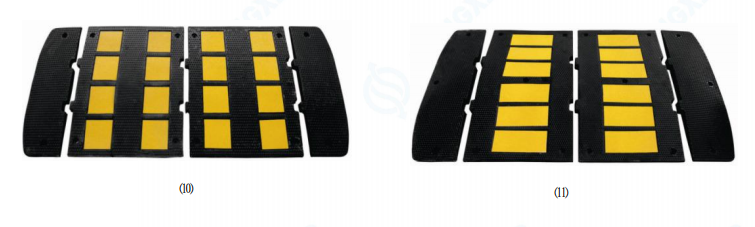
Effective parking management relies on coordinated systems. Wheel stops work alongside speed humps, line striping, and directional signage. Together, they define movement patterns and reinforce space boundaries. Rubber wheel stops integrate seamlessly within these systems. Consistent design language enhances user navigation and reduces confusion in complex commercial layouts. Integrated traffic design improves parking flow efficiency.
Protecting EV Charging Points and Pedestrian Zones
EV charging infrastructure expands rapidly. These stations require protection from accidental vehicle contact. Rubber wheel stops positioned near chargers create a protective buffer. Their impact absorption reduces risk to exposed equipment. In pedestrian-heavy zones, they prevent vehicle encroachment onto walkways. As sustainable transport grows, protective infrastructure becomes increasingly valuable. Align wheel stop placement with EV infrastructure plans during early design stages.
Custom Branding and Color Coding for Organized Parking
Modern commercial properties often use visual identity across all spaces. Recycled rubber wheel stops can include custom colors or logos. It improves space organization and reinforces branding. Color-coded zones guide visitors efficiently. For large retail centers or corporate campuses, clear visual systems enhance user satisfaction and property image. Consistent color coding supports intuitive parking navigation.
Strategic Material Selection for Future-Ready Commercial Developments
Aligning Material Choice with Corporate Sustainability Policies
When corporate sustainability policies guide procurement, material decisions must be supported by measurable data. Developers and facility managers need structured technical information that connects recycled rubber wheel stops to ESG reporting, carbon accounting, and green building certification requirements.
| Evaluation Category | Technical Indicator | Typical Industry Range* | Unit | Practical Application | ESG / Compliance Relevance | Key Considerations |
| Recycled Content | Post-consumer recycled content | 90–100% (manufacturer dependent) | % by mass | Supports circular material sourcing strategies | Contributes to LEED v4 MR Credit (Recycled Content) and ESG disclosures | Verify distinction between post-consumer and pre-consumer content |
| Embodied Carbon | A1–A3 stage embodied carbon (per EPD) | Lower than typical cement-based products (EPD required for exact value) | kg CO₂e/kg | Reduces Scope 3 emissions in material procurement | Requires Environmental Product Declaration (EPD) for reporting | Carbon intensity varies by production process and transport distance |
| Material Density | Recycled rubber density | 900–1200 | kg/m³ | Impacts transport emissions and handling efficiency | Supports logistics-related carbon reduction analysis | Compare with concrete density (~2200–2400 kg/m³) |
| Compressive Behavior | Elastic compressive range | 2–15 | MPa | Adequate for low-speed vehicle impact buffering | Not classified as structural load-bearing | Designed for impact control, not structural support |
| Hardness Rating | Shore A hardness | 60–80 | Shore A | Balances flexibility and positional stability | Supports durability documentation | Excessively low hardness may affect anchoring stability |
| UV Resistance | Accelerated weathering (ASTM G154) | Commonly tested up to 1000+ | Hours | Ensures long-term outdoor color and integrity | Supports maintenance cycle projections | Confirm performance retention after exposure |
| Salt Resistance | Salt spray test (ASTM B117) | 500+ (typical exposure testing) | Hours | Suitable for coastal and de-icing environments | Relevant for durability lifecycle modeling | Confirm latest ASTM standard compliance |
| Installation Impact | Average unit weight (approx. 2 m length) | 10–20 | kg | Reduces heavy machinery use and labor intensity | Supports construction-phase carbon reduction | Compare with concrete stops often exceeding 100 kg |
| Service Life | Estimated operational lifespan | 8–15 (site dependent) | Years | Lowers replacement frequency and waste generation | Supports lifecycle cost and carbon modeling | Traffic volume and climate influence lifespan |
| End-of-Life Recovery | Recyclability potential | Reprocessable through rubber grinding | % recyclable | Reinforces circular economy strategy | May contribute to material recovery rate reporting | Confirm local recycling infrastructure availability |
Tip:For ESG reporting accuracy, prioritize wheel stops that provide third-party verified EPD documentation to ensure traceable carbon and recycled content data.
Future-Proofing Against Climate Variability
Climate patterns grow more extreme. Parking infrastructure must withstand heat, rain, and temperature shifts. Rubber wheel stops resist UV degradation and moisture exposure. They maintain structural integrity in changing weather. Reliable performance under variable conditions protects long-term infrastructure investments. Weather resilience reduces maintenance unpredictability.
Meeting Growing Public Demand for Eco-Friendly Infrastructure
Public expectations around sustainability now influence leasing decisions and brand perception. Visible material choices, such as recycled rubber wheel stops, signal measurable environmental action rather than symbolic commitments. Using post-consumer tire content reduces landfill waste and supports circular material flows. When these features are integrated into parking design, they become tangible proof of responsible development. For commercial landlords, clearly documented sustainable infrastructure strengthens tenant confidence, aligns with corporate climate goals, and enhances competitive positioning in environmentally conscious markets.
Conclusion
Modern parking management demands safety, efficiency, and sustainability. Recycled rubber wheel stops lower carbon impact, reduce maintenance, and improve durability while supporting regulatory compliance. They protect infrastructure and enhance site organization. Chengdu Rongxiang Technology Co., Ltd. delivers high-performance wheel stops engineered for long service life, easy installation, and eco-friendly value, helping commercial projects achieve lasting operational and environmental benefits.
FAQ
Q: What are recycled rubber Wheel Stops?
A: Wheel Stops made from post-consumer tires that improve parking safety and sustainability.
Q: Why choose rubber Wheel Stops over concrete?
A: Rubber Wheel Stops reduce carbon impact, resist cracking, and lower lifecycle maintenance costs.
Q: How do Wheel Stops support green building goals?
A: Recycled Wheel Stops contribute to material credits and strengthen ESG reporting.
Q: Are Wheel Stops easy to install?
A: Yes, rubber Wheel Stops are lightweight and allow fast, single-person installation.
Q: Do Wheel Stops help with ADA compliance?
A: Properly placed Wheel Stops maintain accessible clearances and support regulatory alignment.
 English