
Views: 0 Author: Site Editor Publish Time: 2026-04-21 Origin: Site
Facility managers face a relentless challenge maintaining safe premises. Traditional traffic calming devices frequently crack, warp, or lose visibility under heavy commercial traffic. When delivery trucks cross standard rubber or plastic ramps daily, the materials quickly fail. This forces maintenance teams into endless and expensive repair cycles.
We are now seeing a major shift toward engineered materials in modern infrastructure. Thermoplastic Polyurethane (TPU) effectively solves the severe shortcomings of recycled rubber and basic plastics. It offers remarkable elasticity combined with rigid durability.
This article serves as a comprehensive decision-making guide. You will learn how to evaluate and implement a TPU Speed Hump. We will explore how it balances pedestrian protection, continuous vehicle flow, and facility maintenance requirements. By upgrading your traffic infrastructure, you ensure lasting performance even in the most demanding environments.
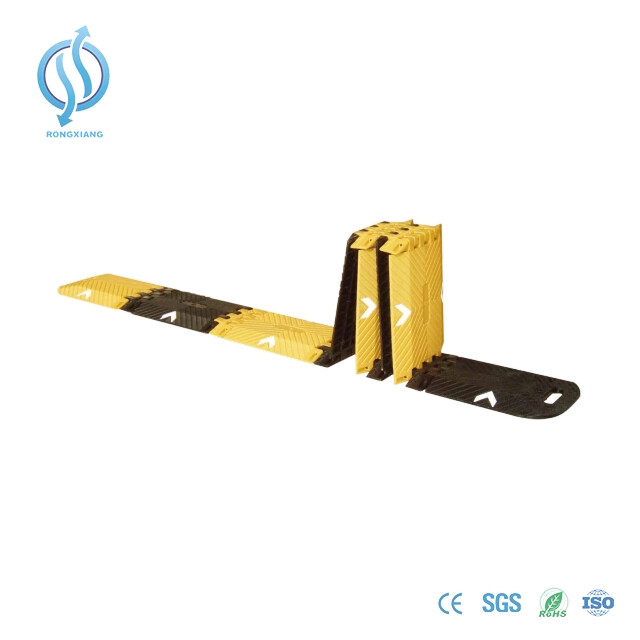
Load Endurance: TPU structural integrity supports up to a 20-ton load capacity, preventing compression failure from delivery trucks and emergency vehicles.
Climate Resilience: Operational reliability across extreme temperature ranges (-40℃ to 60℃) without becoming brittle or melting.
Application Fit: Speed humps (10–15 mph target) provide smoother transitions compared to aggressive speed bumps (2–10 mph target), making them optimal for high-volume parking lots.
Deployment Specs: Correct installation dictates lifespan; precise hardware variations are required for asphalt versus concrete surfaces.
Constantly replacing fractured rubber or shattered plastic speed ramps drains operational budgets. Facility teams repeatedly drill into the same concrete surfaces to install new units. Every new replacement weakens the underlying pavement sub-base. The business problem goes beyond simple replacement parts. Labor hours spent on continual maintenance waste valuable facility resources.
Repeated exposure to heavy axle loads destroys standard materials quickly. Waste management trucks and large delivery vans exert massive localized pressure. Standard recycled rubber compresses too deeply under this weight. Over time, it loses its shape permanently. Basic PVC plastics face a different problem. They lack elasticity. When a heavy garbage truck rolls over rigid plastic, the material simply shatters. Sharp fragments can puncture tires and create immediate site hazards.
Environmental exposure accelerates this physical degradation. Sun exposure fades painted visibility stripes rapidly. Freeze-thaw cycles cause traditional materials to contract and expand unevenly. They soon crack around their bolt holes. Once the bolting points fail, the units lose their critical anchoring. They shift dangerously across travel lanes.
A degraded infrastructure directly threatens parking lot safety. Faded colors fail to warn approaching drivers. Loose ramps become severe tripping hazards for pedestrians. You might face serious compliance issues if your traffic control measures fall into disrepair. Upgrading your materials eliminates these overlapping risks.
TPU acts as a perfect bridge between different material categories. It combines the elasticity of rubber and the immense durability of rigid plastics. You get vital flexibility without sacrificing structural strength. TPU resists automotive fluids perfectly. Motor oil, gasoline, and antifreeze often cause standard rubber to swell and crumble. TPU repels these chemicals, maintaining its original density.
How does it handle commercial trucks? It relies on advanced structural engineering. The bottom of the unit features a rugged grid backing. This disperses extreme commercial weight outward across the pavement. It easily supports a 20-ton load capacity without permanent deformation. When heavy machinery rolls over, the grid absorbs the massive shock. The material then springs back instantly to its original shape.
Wet weather causes dangerous slip hazards. TPU products integrate high reflective color schemes directly into the mold. Paint peels off quickly, but molded inserts stay bright permanently. These units also feature engineered surface textures. Raised chevron patterns maintain strong grip during rain or snow. Pedestrians walk securely. Vehicles stop without sliding or losing traction.
Outdoor deployment demands extreme weather tolerance. TPU maintains its physical properties across a vast temperature range. It stays reliable from -40℃ to 60℃. It will not melt or warp in extreme summer heat. It refuses to turn brittle during freezing winter storms. Built-in UV resistance prevents the vibrant warning colors from washing out over time.
Material Type | Elasticity | Load Rating | Chemical Resistance | Lifespan Expectancy |
|---|---|---|---|---|
Recycled Rubber | High | Low (Compresses) | Poor (Swells) | 1 - 3 Years |
Rigid PVC Plastic | Low (Brittle) | Medium (Cracks) | Good | 2 - 4 Years |
Engineered TPU | Balanced | High (20-Ton) | Excellent | 5+ Years |
Many facility managers confuse speed humps and speed bumps. They serve completely different traffic management goals. A speed hump features a broad, parabolic profile. It usually spans several feet in travel length. A speed bump features an abrupt, narrow profile. It rises sharply over a very short distance.
Speed reduction targets dictate which device you should install. Speed humps target 10 to 20 mph. They are ideal for continuous traffic flow. We see them used successfully in residential zones and main parking lot arteries. Speed bumps target a much lower 2 to 10 mph limit. They are highly aggressive. You should only use them for tight stop zones. Toll booths and specific pedestrian crosswalks benefit from bumps.
You must consider the vehicle impact assessment. The gentle slope of a speed hump protects low-clearance vehicles. It glides the vehicle up and down smoothly. Approaching at the correct speed causes no jarring suspension impacts. Aggressive speed bumps can severely scrape chassis components. They often ruin shocks on lowered cars. Choosing the broader hump design maintains safety without angering drivers.
Feature | Speed Hump | Speed Bump |
|---|---|---|
Target Speed | 10 - 20 mph | 2 - 10 mph |
Design Profile | Broad, parabolic slope | Narrow, abrupt rise |
Primary Application | Main roads, large parking lots | Toll booths, tight stops |
Vehicle Impact | Gentle transition | Aggressive jolt |
The failure point of a speed hump is rarely the TPU material itself. Improper anchoring causes almost all early failures. Many installers use the wrong hardware for their pavement type. If you use concrete anchors in soft asphalt, they will rip out within weeks. You must match the hardware to the surface.
Asphalt deployment requires specific long hardware. Asphalt is a soft, flexible sub-base. You must drill holes to a 150mm depth. Installers must use 150mm length by 12mm diameter steel spikes. These long spikes drive deep into the sub-base. They grip the dense layers below the soft topcoat. Expansion bolts fail in asphalt because the material cannot hold the outward pressure.
Concrete deployment requires different mechanics entirely. Concrete is rigid and highly dense. You still require 150mm depth drilling. However, you must use 120mm length by 10mm diameter expansion bolts. When tightened, the metal sleeve expands outward. It bites fiercely into the hard concrete walls. This provides an immovable anchor point.
The interlocking design drastically improves the installation process. Interlocking modular sections allow for custom widths. You can easily span specific travel lanes edge-to-edge. Standard units weigh around 12kg each. This permits single-worker installation without needing heavy lifting equipment.
Follow these best practices for a standard lane installation:
Sweep the installation area completely free of debris.
Lay out the interlocking modular sections across the lane.
Use chalk to mark the precise locations of the mounting holes.
Remove the sections and drill the holes to the required 150mm depth.
Clear dust from the holes, reposition the units, and drive the appropriate hardware.
Assuming pre-marked lines and a standard hammer drill, one worker finishes a typical lane in under 45 minutes.
Selecting the right product requires careful vetting. Do not rely entirely on basic marketing claims. You should systematically evaluate the technical specifications and structural features.
Verification of Specs: Advise buyers to request independent load-bearing certifications. You need proof verifying the 20-ton claim. Ask for laboratory UV resistance data. This ensures the yellow hazard sections will not bleach white in the summer sun.
Surface Adhesion & Drainage: Check the bottom profile. Look for molded bottom-channel designs. These channels allow rainwater to pass safely beneath the hump. Proper drainage prevents dangerous lot pooling and winter ice patches.
Portability vs. Permanent Fixation: Evaluate your true facility needs. Does your site require a fixed interlocking system for permanent lanes? Perhaps you need a foldable TPU option for temporary event deployment. Pop-up sites and emergency response zones often benefit from modular temporary units.
Warranty & Supplier Trust: Look for highly transparent warranty terms. A trustworthy supplier covers material delamination. They should also guarantee hardware pull-out resistance under stated conditions. Avoid suppliers offering only vague, limited replacement terms.
A common mistake is ignoring the site's daily traffic mix. Never install a residential-grade ramp at a warehouse loading dock. Audit your heavy truck volume before finalizing any purchase order.
Upgrading to an engineered TPU speed hump shifts your facility management strategy. You move from a recurring maintenance headache to a reliable, long-term safety asset. Modern materials eliminate the frequent cracking, shifting, and fading associated with basic rubber and plastic alternatives. Your maintenance staff can finally focus on other pressing operational tasks.
We advise facility managers to audit their current traffic volume carefully. Identify your primary vehicle types before specifying the unit length. Always confirm your exact paving surface to order the correct anchoring hardware. Precision matters during the planning phase.
Take action today to secure your site. Consult with a traffic safety specialist about your specific layout. Request technical specification sheets for your exact asphalt or concrete surface. Investing in durable infrastructure guarantees a safer environment for drivers and pedestrians alike.
A: No. The wider parabolic shape and flexible nature of TPU provide a gradual transition. This design gently lifts and lowers the vehicle, preventing chassis scraping when approached at the posted speed limit.
A: Assuming pre-marked lines and a standard hammer drill, a single worker can typically install standard sections in 30 to 45 minutes per lane. The lightweight 12kg modular design makes handling very easy.
A: While highly durable, snowplow blades can catch the edges of any surface-mounted traffic calming device. It is recommended to use markers to alert plow drivers to raise their blades slightly, or use temporary/removable models during heavy winter months.
A: Yes. TPU generally offers superior resistance to automotive fluids like motor oil, gasoline, and antifreeze. These caustic fluids frequently cause standard recycled rubber to swell, crumble, and degrade over time.
 English


