Views: 0 Author: Site Editor Publish Time: 2026-08-10 Origin: Site
Operating a commercial, industrial, or municipal facility requires constant vigilance over physical safety hazards. Degraded threshold equipment presents immediate operational, accessibility, and liability risks. Facility managers and safety officers must ensure seamless transitions across doorways and elevation changes. Solid rubber ramps offer exceptional durability and require minimal upkeep. However, environmental factors like UV degradation and extreme temperature fluctuations take a toll. Continuous heavy dynamic loads from carts, hand trucks, and mobility devices eventually compromise structural integrity. Over time, you will notice a loss of slip resistance and slope accuracy. Ignoring these warning signs exposes your facility to compliance violations and physical injuries. You need a technical evaluation framework to audit existing installations effectively. Identifying critical failure points early prevents accidents. Facility managers and homeowners must specify the correct rubber threshold ramp replacement to ensure long-term ADA compliance and safety. Upgrading worn materials restores secure access and mitigates liability.
Visual and Structural Degradation Dictates Timelines: Surface wear, edge curling, and material crumbling are primary indicators that a ramp no longer provides safe traction or adequate door clearance.
Compression Alters ADA Compliance: Prolonged heavy use can compress rubber, altering the strict 1:12 slope ratio required for wheelchair and mobility device accessibility.
Material Selection Matters: Replacing a ramp requires evaluating rubber versus alternative materials like aluminum, balancing slip resistance, noise dampening, and cost-effectiveness.
Application Dictates Material Grade: High-traffic commercial environments require industrial-grade materials, often overlapping with heavy-duty roadway safety products, rather than standard residential solutions.
Supplier Vetting is Critical: Partnering with a verified commercial safety product supplier ensures access to load-tested materials, accurate dimensional tolerances, and custom configurations.
A functional threshold ramp must meet specific baseline performance expectations. It needs a consistent slope, a high coefficient of friction, flush edges, and unobstructed door operation. When any of these criteria fail, the ramp becomes a hazard rather than an aid. Recognizing the early signs of wear allows you to schedule a replacement before an incident occurs. Field inspections should occur quarterly, focusing on the physical condition of the rubber and its interaction with the surrounding substrate.
Facility maintenance teams often overlook threshold ramps until a failure happens. You must train your staff to identify the subtle indicators of material fatigue. A ramp might look intact from a distance, but close inspection often reveals micro-cracking, compression sets, and loss of surface texture. These issues compromise the safety of pedestrians and the efficiency of material handling equipment.
Environmental weathering severely impacts rubber compounds over time. UV degradation breaks down the chemical bonds in the material. Ozone exposure and extreme temperature cycling accelerate this process. You will first notice surface micro-cracking. As the damage progresses, the edges and high-friction surfaces begin crumbling. This structural breakdown compromises the ramp's ability to bear weight safely. In outdoor applications, such as loading docks or exterior entryways, this degradation happens much faster than indoors.
Continuous point-loading exacerbates environmental damage. Heavy mobility devices, hand trucks, and commercial carts exert immense pressure on concentrated areas. This localized material fatigue leads to permanent indentation. The rubber loses its structural density and fails to rebound. Once the material compresses permanently, it can no longer support dynamic loads without shifting or tearing. You will often see chunks of rubber missing from the leading edge where cart wheels strike the ramp repeatedly.
To assess structural degradation, perform a physical push test. Press firmly on the center and edges of the ramp. If the material feels spongy or fails to return to its original shape immediately, the internal structure has failed. Look for black dust or small rubber particles accumulating around the base of the ramp. This debris indicates active crumbling and signals that the ramp has reached the end of its functional lifespan.
Molded slip-resistant treads and grooved channels provide essential grip. Abrasive wear from heavy foot traffic and rolling loads grinds these textures down. Over time, the aggressive tread patterns become smooth. This degradation happens gradually, often going unnoticed until a slip occurs. Routine inspections must include a tactile assessment of the ramp's surface. Run your hand over the main traffic path. If it feels significantly smoother than the outer edges, the traction is compromised.
Worn, smooth rubber transforms into a severe slip-and-trip hazard. This danger multiplies in wet, icy, or oily conditions. The ramp's primary safety function is negated when it cannot provide secure traction. Replacing the unit restores the necessary friction coefficient to keep pedestrians and equipment stable during transitions. Facilities operating in regions with heavy rainfall or snow must prioritize traction above all other metrics.
You can measure the coefficient of friction using a specialized slip meter. While this level of testing is usually reserved for large commercial audits, a simple visual and tactile check suffices for most applications. If the molded grooves are less than half their original depth, schedule a replacement. Do not attempt to restore traction by cutting new grooves into old rubber. This weakens the material further and accelerates structural failure.
Temperature-induced expansion and contraction affect the physical shape of the ramp. The tapered, thin edges are particularly vulnerable. Extreme heat causes the material to expand, while cold causes it to shrink. This continuous cycling often makes the edges curl upwards away from the floor. Curled edges create an immediate tripping hazard for anyone crossing the threshold. They also catch the wheels of carts and wheelchairs, causing abrupt stops that can lead to injury or spilled loads.
Warped or improperly sized ramps frequently block the door swing. A replacement ramp must sit slightly lower than the door sill. This clearance allows the door to open freely over the rubber surface without binding or dragging. If the ramp rubs against the bottom of the door, it accelerates wear on both surfaces and impedes emergency egress. You must measure the gap between the bottom of the door and the floor throughout the entire swing arc.
The operational risks of edge curling are significant. Raised edges catch on shoes, wheelchair casters, and cart wheels. They interfere with the smooth swing of doors, directly violating accessibility standards. Prompt replacement eliminates these hazards and restores compliance. When installing a new ramp, ensure it is acclimated to the room temperature before anchoring to minimize future thermal expansion issues.
Ignoring ramp degradation carries severe legal, physical, and financial consequences. Facilities must address these implementation risks proactively. Delaying necessary upgrades exposes organizations to unnecessary vulnerabilities. Maintaining safe access is a continuous obligation, not a one-time installation task. A degraded ramp is a visible sign of deferred maintenance, which can negatively impact the perception of your facility.
When budgets are tight, facility managers often push threshold ramp replacement to the next fiscal year. This is a dangerous gamble. The cost of a single slip-and-fall claim far exceeds the price of a new commercial-grade ramp. You must view these replacements as essential safety investments rather than optional aesthetic upgrades.
The Americans with Disabilities Act (ADA) enforces strict regulatory standards for threshold transitions. The law requires a maximum 1:12 slope ratio. This means you need one inch of rise for every 12 inches of run. This specific geometry ensures manual wheelchair users can navigate the incline safely without excessive physical exertion or tipping backward. Any deviation from this ratio constitutes a compliance failure.
Material compression and structural sag alter this critical geometry. Heavy traffic compresses the rubber, steepening the approach angle. Shifting materials create uneven transitions at the top and bottom edges. These changes render the threshold ramp non-compliant. An altered slope is unsafe for manual wheelchair users and violates federal accessibility guidelines. A ramp that originally measured 1:12 can easily compress to a 1:10 or 1:8 ratio over several years of heavy use.
To verify compliance, use a digital smart level. Place it directly on the ramp surface along the path of travel. The reading should not exceed 4.76 degrees (which corresponds to a 1:12 slope). Check multiple points along the ramp, as compression often occurs unevenly. If any section exceeds the maximum allowable slope, you must replace the unit immediately.
Facility managers face increased liability if accidents occur due to neglected infrastructure. A slip-and-fall incident on a non-compliant ramp invites intense scrutiny. Legal investigations will focus on maintenance records and the physical condition of the threshold. Failing to replace a visibly degraded ramp demonstrates negligence. Plaintiff attorneys will specifically look for curled edges, smooth surfaces, and incorrect slopes during their site inspections.
Proactive replacement serves as a cost-effective risk mitigation strategy. The expense of a new ramp is minimal compared to potential litigation. Insurance premium hikes and workers' compensation claims quickly drain operational budgets. Maintaining safe, compliant entryways protects both the public and the organization's financial health. Document every inspection and replacement in your facility management software to build a verifiable record of safety compliance.
Selecting the appropriate replacement requires evaluating specific use cases. You must account for traffic volumes, environmental conditions, and structural demands. Guiding your facility through this selection process ensures the new asset performs reliably for years. Do not simply order the exact same model you are replacing without first assessing if the operational demands of that doorway have changed.
Consider the types of loads crossing the threshold. A doorway that previously only saw foot traffic might now handle heavy motorized pallet jacks. This change in use dictates a change in material specification. You must match the ramp's load capacity and density to the heaviest equipment that will use it.
Comparing performance characteristics helps determine the best material for your replacement cycle. Both rubber and aluminum offer distinct advantages depending on the application environment. You must weigh these factors against your specific facility requirements.
Performance Metric | Solid Vulcanized Rubber | Extruded Aluminum |
|---|---|---|
Slip Resistance | Excellent natural grip, maintains high COF even when wet. | Requires applied grit tape or punched traction holes which wear out. |
Noise Dampening | Absorbs impact noise from wheels and footsteps effectively. | Loud and clanky under heavy rolling loads; amplifies sound. |
Field Customization | Easily trimmed on-site with a utility knife to fit irregular door jambs. | Requires specialized metal-cutting tools and deburring for modifications. |
Weight Capacity | High compression strength for heavy solid loads; conforms to slight floor variations. | High structural strength, but can dent under point loads; requires perfectly flat substrate. |
Corrosion Resistance | Impervious to rust; highly resistant to most commercial de-icing salts. | Will not rust, but can oxidize or react poorly to certain harsh industrial chemicals. |
Rubber provides superior slip resistance and noise reduction under heavy foot and wheel traffic. It absorbs impact energy, protecting the underlying substrate. Installers can easily custom trim rubber on-site to fit irregular door frames perfectly. Aluminum might be considered in areas with extreme chemical exposure where rubber would degrade. However, rubber remains the standard for quiet, high-traction, and highly adaptable transitions in most commercial and industrial settings.
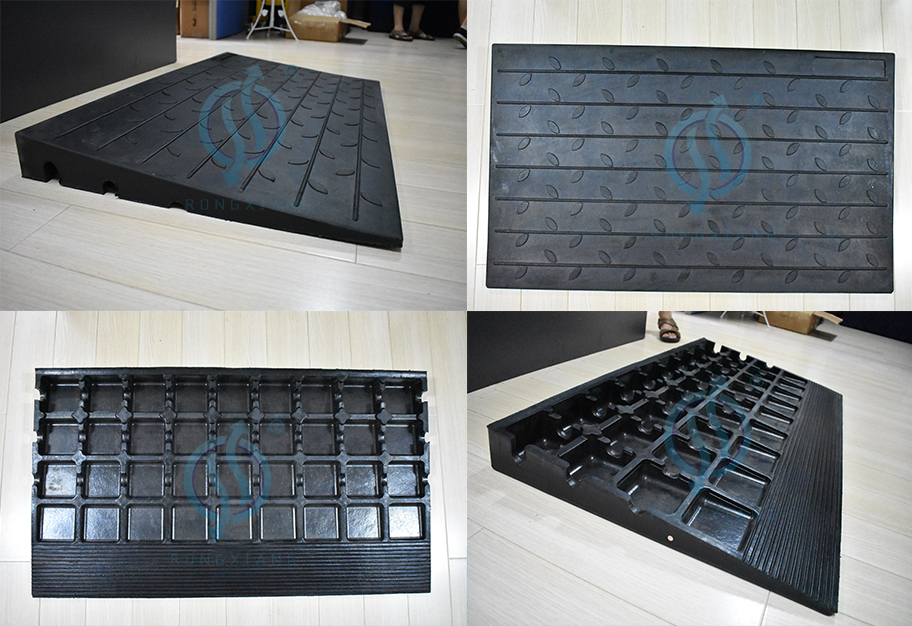
Standard residential rubber ramps cannot withstand commercial abuse. Industrial-grade alternatives feature higher density and better UV resistance. Facility managers should look toward heavy-duty roadway safety products for demanding environments. High-density vulcanized rubber handles extreme weight without compressing. These products are engineered using the same compounds found in traffic calming devices and industrial wheel chocks.
These heavy-duty solutions are essential for loading docks and commercial entryways. Areas with motorized equipment and heavy machinery traffic require robust materials. Utilizing roadway-grade rubber ensures the ramp survives forklift traffic, pallet jacks, and constant commercial deliveries without failing. When evaluating these products, check the Shore A durometer rating. A rating between 65 and 75 indicates a hard, durable rubber suitable for heavy industrial use.
Do not install hollow-core or lightweight foam-filled ramps in commercial settings. They will crush under the weight of a loaded pallet jack. Always specify solid, molded rubber for any application involving wheeled freight or motorized mobility devices.
Off-the-shelf sizing often falls short in commercial facilities. Non-standard door frames, uneven flooring transitions, and unique architectural thresholds require tailored solutions. A standard ramp might leave dangerous gaps or overhangs. It may not provide the exact 1:12 slope required for a specific rise. Trying to force a standard ramp into a non-standard space usually results in a compromised installation that fails prematurely.
Evaluate your space carefully when specifying a custom replacement threshold ramp. Focus on beveled or edgeless designs. These configurations allow multi-directional side approaches. Eliminating harsh vertical drop-offs on the sides removes lateral trip hazards, ensuring safe access from any angle. Custom ramps can be manufactured to accommodate specific rises down to the millimeter, ensuring a perfectly flush transition against the door sill.
When ordering a custom ramp, provide the manufacturer with precise measurements. You need the exact rise height, the usable width of the door opening, and the available run space before the ramp interferes with other architectural elements. Photographs of the threshold from multiple angles also help the engineering team design the optimal profile.
Assessing vendors ensures product reliability, compliance, and institutional trust. You need a framework to evaluate potential partners. Sourcing from reputable manufacturers guarantees you receive materials engineered for commercial demands. Do not purchase safety infrastructure from generic online marketplaces where material specifications are often exaggerated or entirely fabricated.
A reliable supplier acts as a technical consultant, not just a vendor. They should ask detailed questions about your application, traffic volume, and environmental conditions before recommending a product. If a supplier simply points you to a catalog without verifying your needs, look elsewhere.
Request specific technical specifications from any verified commercial safety product supplier. Ask for durometer ratings to understand material hardness. Verify weight capacities to ensure the ramp supports your heaviest loads. Inquire about recycled versus virgin rubber content, as this affects longevity and odor. Always review the warranty terms. A standard commercial warranty should cover structural integrity for at least one year under normal use.
Evaluate the supplier's compliance documentation thoroughly. They must guarantee adherence to ADA, OSHA, and local accessibility standards. Request testing certificates that prove the ramp maintains its slope and traction under stated load conditions. Reliable documentation protects your facility during safety audits. Ask for the Material Safety Data Sheet (MSDS) to ensure the rubber compound does not emit harmful volatile organic compounds (VOCs) in enclosed indoor spaces.
Check the manufacturing tolerances. High-quality suppliers maintain strict dimensional tolerances, ensuring the ramp you receive matches the specifications exactly. Poorly manufactured ramps often have uneven thicknesses or warped edges right out of the box, making a flush installation impossible.
There are distinct advantages to sourcing directly from a roadway safety equipment manufacturer or a specialized rubber threshold ramp supplier. Direct sourcing often provides access to bulk pricing for large facility upgrades. You benefit from superior material engineering derived from highway safety applications. Manufacturers also supply rigorous product testing data that third-party distributors rarely possess.
Customer support is a critical factor. Look for flexible return policies and responsive technical assistance. The best manufacturers provide engineering consultation on complex accessibility challenges. They help you design custom configurations for highly irregular thresholds, ensuring perfect fit and compliance. They can also advise on the best adhesives and anchoring methods for their specific rubber compounds.
Establish a long-term relationship with your chosen manufacturer. This ensures consistency across your facility as you replace ramps over time. Using the same brand and material type maintains a uniform aesthetic and predictable maintenance schedule throughout your buildings.
Executing the replacement properly maximizes the lifespan and safety of the new asset. Practical installation steps dictate how well the ramp performs under stress. Proper anchoring and routine maintenance are non-negotiable for commercial applications. A poorly installed premium ramp will fail just as quickly as a cheap one.
Before beginning the installation, gather all necessary tools. You will need a heavy-duty utility knife, a straight edge, a tape measure, a digital level, a caulk gun for adhesive, and appropriate personal protective equipment. Ensure the work area is cordoned off to prevent pedestrian traffic during the installation process.
Analyze your specific use case before installation. Permanent installations suit high-traffic commercial spaces where the ramp will remain indefinitely. Temporary or portable setups work best for residential visitors, event venues, or evolving job sites. Portable ramps offer quick deployment but require secure placement to prevent shifting.
Consider the trade-offs of portability versus stability. Portable units are easy to store and move but may slide under heavy acceleration from motorized chairs. Permanent anchoring ensures the ramp never shifts, providing maximum safety at the cost of mobility. In commercial settings, permanent anchoring is almost always the correct choice to mitigate liability and ensure consistent ADA compliance.
Proper surface preparation prevents premature failure. Remove the old, degraded ramp completely. Scrape away all residual adhesives and neutralize any chemical contaminants on the floor. Repair the underlying substrate, whether it is concrete, wood, or metal, ensuring a flat, solid base for the new installation. If you install a new rubber ramp over spalled or uneven concrete, the rubber will eventually conform to those defects, creating an uneven surface.
Follow these steps for a secure permanent installation:
Dry fit the ramp against the threshold to verify width and rise. Mark any areas that require trimming.
Trim the rubber using a sharp utility knife and a straight edge. Make multiple shallow passes rather than trying to cut through the entire thickness at once.
Clean the floor substrate and the bottom of the rubber ramp with a denatured alcohol solution to remove dust and mold-release agents.
Apply a high-quality polyurethane construction adhesive to the floor in a serpentine pattern.
Press the ramp firmly into the adhesive. Apply heavy weights (such as sandbags) evenly across the surface of the ramp.
Allow the adhesive to cure completely according to the manufacturer's specifications before opening the area to traffic.
For extreme heavy-duty applications, such as loading docks, you may need to use mechanical concrete anchors in addition to adhesive. Drill through the pre-marked countersunk holes in the ramp, insert the concrete anchors, and tighten them flush with the rubber surface.
Rubber threshold ramps are celebrated for low upkeep, but periodic checks remain essential. Implement a preventative maintenance checklist to extend the life of the new ramp. Clear surface debris regularly to maintain traction. Wash the rubber with mild soap and water to remove oils and dirt. Do not use harsh petroleum-based solvents, as these will degrade the rubber compound.
Check edge flushness frequently to prevent trip hazards. Ensure the door swing remains unobstructed throughout the changing seasons. Monitor the high-traffic zones for early signs of compression or tread wear. Catching these issues early allows for minor adjustments before a full replacement becomes necessary.
Inspection Task | Frequency | Action Required if Deficient |
|---|---|---|
Clear surface debris and dirt | Weekly | Sweep or hose down the ramp surface. |
Check for edge curling or lifting | Monthly | Re-apply adhesive or install mechanical anchors. |
Verify door clearance | Quarterly | Adjust door sweep or trim ramp slightly if rubbing occurs. |
Measure slope with digital level | Bi-Annually | Replace ramp if slope exceeds 1:12 ratio due to compression. |
Inspect tread depth for traction | Annually | Replace ramp if molded grooves are worn smooth. |
Proactive maintenance preserves your investment. Document all inspections to maintain a clear record of safety compliance. This diligence protects your facility from liability and ensures continuous, safe access for everyone.
Measure your existing threshold rise accurately using a digital level to determine the exact run required for a compliant 1:12 slope.
Document current ramp deficiencies by photographing areas of crumbling, edge curling, or traction loss for your facility maintenance logs.
Check door clearance heights with a tape measure to ensure the new ramp profile will not obstruct the swing path.
Contact a reputable manufacturer to verify load requirements and specify the correct material density for your traffic volume.
A: A high-quality commercial rubber ramp typically lasts 5 to 10 years. Lifespan variables include foot and vehicular traffic volume, UV exposure, and material density. Indoor ramps in climate-controlled environments last significantly longer than those exposed to harsh outdoor weather and heavy machinery.
A: It depends on your environment. Rubber offers superior traction, noise dampening, and impact absorption, making it ideal for high-traffic pedestrian areas. Aluminum is better suited for environments with extreme chemical exposure or where a lightweight, easily portable folding ramp is required.
A: Use a digital level or slope calculator to verify the 1:12 ratio (one inch of rise per 12 inches of run). Check for flush transitions at the top and bottom edges. If the rubber has compressed, altered the angle, or curled at the edges, it is no longer compliant.
A: Measure the clear space beneath the door swing accurately. Select a ramp height that sits slightly lower than the bottom edge of the door. The door must open freely over the ramp without rubbing or binding against the rubber surface.
A: Yes. One of the primary benefits of solid rubber ramps is that they can be easily trimmed on-site. Use a sharp utility knife and a straight edge to cut the rubber to match the specific contours of your door jambs or baseboards.
 English